Guides
Swedish Dishcloth vs Sponge: Which Cleans Better?
September 11, 2026

Standing at the sink with a slimy sponge in one hand and a sticky pan in the other is a familiar kitchen moment. Sponges soak, but they also hold onto smell. Paper towels pile up in the trash. A Swedish dishcloth sits in the middle: soft enough to wipe counters, tough enough (with the right design) to scrub stuck-on food, and reusable for months.
So which cleans better—a Swedish dishcloth or a sponge? It depends on what you mean by “better.” Below we compare absorbency, scrubbing power, hygiene, waste, and everyday use so you can pick what actually fits your kitchen.
Quick answer: Swedish dishcloth vs sponge
For everyday wipe-downs, spills, and light scrubbing, a well-made Swedish dishcloth usually wins on absorbency, drying speed, and how little trash it creates. A classic kitchen sponge can still feel familiar for heavy soap foam, but it often stays wet longer and needs replacing more often.
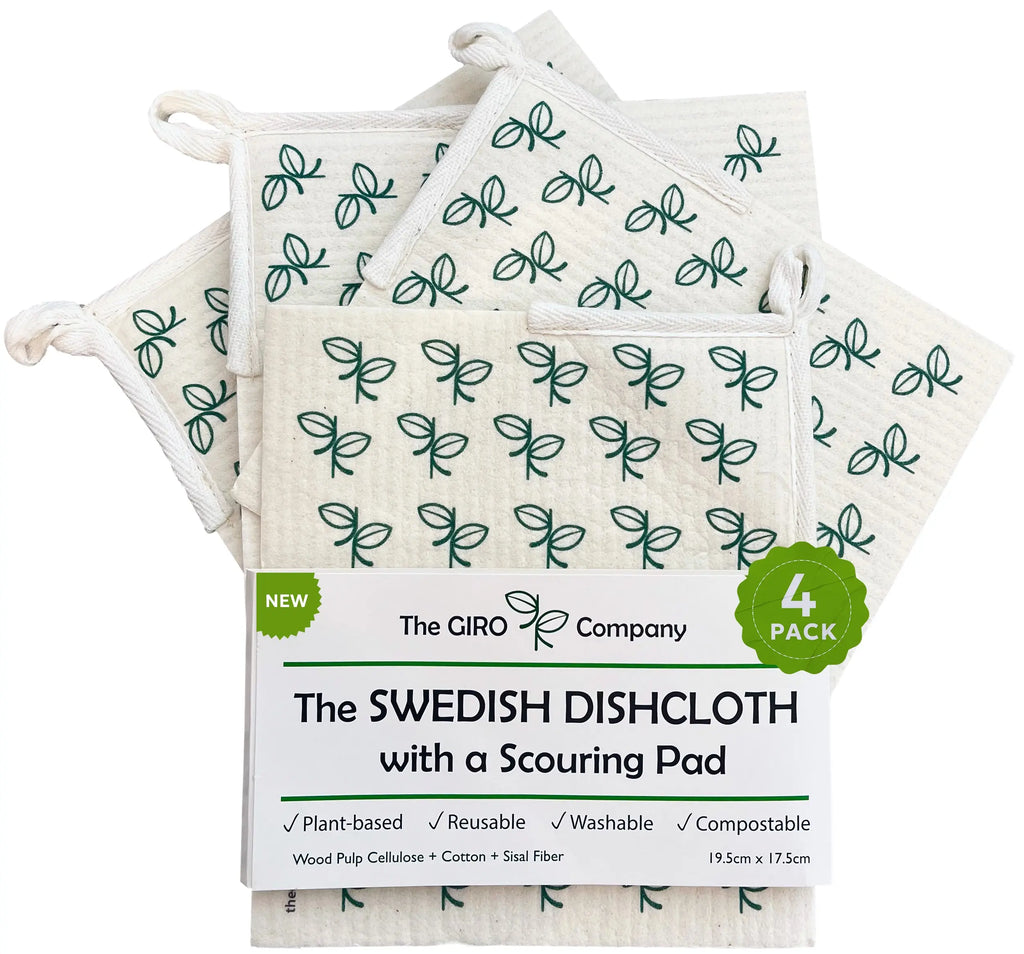
Giro’s Swedish dishcloths add a patent-pending sisal scouring corner on the same cloth—so you wipe with the soft surface and scrub stuck bits with the corner, without grabbing a separate scrubber.
What is a Swedish dishcloth?
A Swedish dishcloth is a thin, flexible cleaning cloth made from plant-based fibers. Giro’s cloths are about 8" x 7" and use 70% cotton and 30% FSC wood pulp cellulose. When wet, they become soft and highly absorbent—ours soak up about 15x their weight.
When dry, they stiffen a bit, which helps them air out between uses. Hang one after rinsing and it dries faster than a thick sponge, which is one reason many people notice less odor.
One cloth can replace up to 15 paper-towel rolls. A 4-pack is roughly 60 rolls of paper towels you do not buy or toss. Packs also come in 8 and 16 if you want extras for bathrooms, the garage, or guests.
What a sponge does well (and where it struggles)
Sponges are great at holding soapy water and scrubbing with a rough side. That familiar two-sided design is why they still live under so many sinks.
The trade-offs show up after a few days:
- They stay damp. Thick foam holds moisture, which is where kitchen odors start.
- They wear out. Edges fray, the scrubbing face flattens, and you replace them often.
- They are usually not compostable. Many sponges include synthetic foam or plastic scrub layers that end up in the trash.
- They are one job at a time. Wipe, scrub, rinse—but you still reach for paper towels for spills on the counter.
Absorbency and drying: cloth vs sponge
Swedish dishcloths are built to drink spills. Giro cloths absorb about 15x their weight, so a wet counter or a tipped glass is usually one wipe—not a stack of paper towels.
Sponges absorb too, but they release water slowly and stay heavy. That lingering dampness is why a sponge can smell after a busy cooking week even if you rinse it.
Care tip for cloths: rinse after use, hang dry, and skip fabric softener (it coats fibers and hurts absorbency). For a deeper clean, machine-wash or place the cloth on the dishwasher top rack.
Scrubbing power: sisal scouring corner vs sponge scrub side
This is where Giro’s design differs from a plain Swedish dishcloth and from a sponge.
Each Giro cloth has a patent-pending sisal scouring corner—sisal fiber worked into one corner of the same cloth, not a separate scouring layer glued across a whole face. Use the soft cotton-cellulose area for dishes, glass, stainless, and counters. Flip to the sisal corner when something is stuck on a pan or the stovetop.
A sponge’s rough side can scrub well when new, but it is a different tool: bulkier, slower to dry, and often made with materials you will not compost. With Giro, wipe and scrub live on one flat cloth you can hang to dry.
Hygiene and smell
Neither tool is “self-cleaning.” What matters is how fast it dries and how easy it is to wash.
- Swedish dishcloth: Thin profile + hang drying = faster dry time for many kitchens. Wash in the machine or dishwasher top rack when you want a reset.
- Sponge: Foam cores stay wet longer. Many people microwave or boil sponges; that can help short-term, but replacement is still frequent.
Expect about 2–3 months of regular kitchen use per Giro cloth with normal care—not a half-year miracle, just honest reuse instead of daily disposables.
Waste, materials, and end of life
Giro cloths are plastic-free, biodegradable, and compostable when worn out. They are also claimed under OEKO-TEX Standard 100. That is a cleaner story than most foam sponges and a much smaller trash footprint than paper towels.
If your goal is fewer bags of kitchen waste, swapping sponges and paper towels for a small stack of Swedish dishcloths is one of the simplest changes you can make.
Side-by-side comparison
| Feature | Giro Swedish dishcloth | Typical kitchen sponge |
|---|---|---|
| Size / feel | ~8" x 7", flat, flexible | Thick foam block |
| Materials | 70% cotton, 30% FSC wood pulp cellulose | Often synthetic foam + scrub layer |
| Absorbency | About 15x its weight | Good when wet; stays heavy |
| Scrubbing | Sisal scouring corner on the same cloth | Rough face (varies by brand) |
| Drying | Hangs; dries relatively fast | Stays damp longer |
| Care | Machine wash / dishwasher top rack; no softener; hang dry | Rinse; replace often |
| Lifespan | ~2–3 months with regular use | Often weeks |
| End of life | Biodegradable / compostable | Usually landfill |
| Paper towel swap | 1 cloth ≈ up to 15 rolls | Not a paper-towel replacement |
When a sponge might still make sense
If you love a very thick soapy scrub for cast iron or outdoor gear, keep a dedicated scrubber for that job. For counters, dishes, spills, glass, and daily wipe-downs, most households do fine—and cleaner—with Swedish dishcloths alone.
How to switch without overthinking it
- Start with a 4-pack (or 8/16 if you want backups).
- Wet the cloth, wring it, and wipe as you would with a sponge or paper towel.
- Use the sisal scouring corner only where food is stuck.
- Rinse, hang dry, and wash weekly (or whenever it needs it).
- Retire a cloth after a few months of heavy use and compost it if your setup allows.
The bottom line
A sponge cleans—but it often stays wet, smells sooner, and ends up in the trash. A Swedish dishcloth cleans across more of the kitchen: spills, counters, dishes, and light scrubbing, with less waste.
Giro’s version pairs a soft 70% cotton / 30% cellulose cloth with a patent-pending sisal scouring corner so you are not juggling two tools. About 8" x 7", absorbs 15x its weight, lasts roughly 2–3 months, and comes in 4, 8, and 16 packs.
Ready to try the swap? Grab a pack, hang one by the sink, and see how many paper towels and tired sponges you stop reaching for.
Buy Swedish Dishcloths on The Giro Company
Still deciding? Browse our FAQs or shop Swedish dishcloths.
Questions? Email us at help@thegirocompany.com.