Guides
How to Choose a Swedish Dishcloth: 7 Things That Matter
October 20, 2026

Here's an honest secret: most Swedish dishcloths are more alike than their packaging suggests. The base idea is the same everywhere, a flat, sponge-like sheet of plant fibers that soaks up spills and dries fast. What separates a cloth you love from one you quietly abandon under the sink comes down to seven details. Check these and you can buy any brand, ours or not, with confidence.
1. The blend
Look for wood pulp cellulose and cotton, and nothing else. Giro uses 70% cellulose (plant-based wood pulp) and 30% cotton. Cellulose does the absorbing; cotton adds strength so the cloth survives the washing machine and the dishwasher. Skip blends that add polyester or other synthetics. They shed, they don't biodegrade, and they defeat the purpose of switching in the first place. (Curious how the two fibers work together? Here's what Swedish dishcloths are made of.)
2. Size, thickness and absorbency
Standard is roughly 7 by 8 inches, and ours is about 8×7 in. Much smaller and it can't handle a real spill. Thickness is harder to judge online, so read reviews for words like "thin" or "fell apart." A good cloth feels like a dense, flat sponge once it's wet, and it should hold a lot of liquid: a Giro cloth absorbs up to 15x its weight, which is why one cloth can stand in for a whole stack of paper towels.
3. Can it scrub?
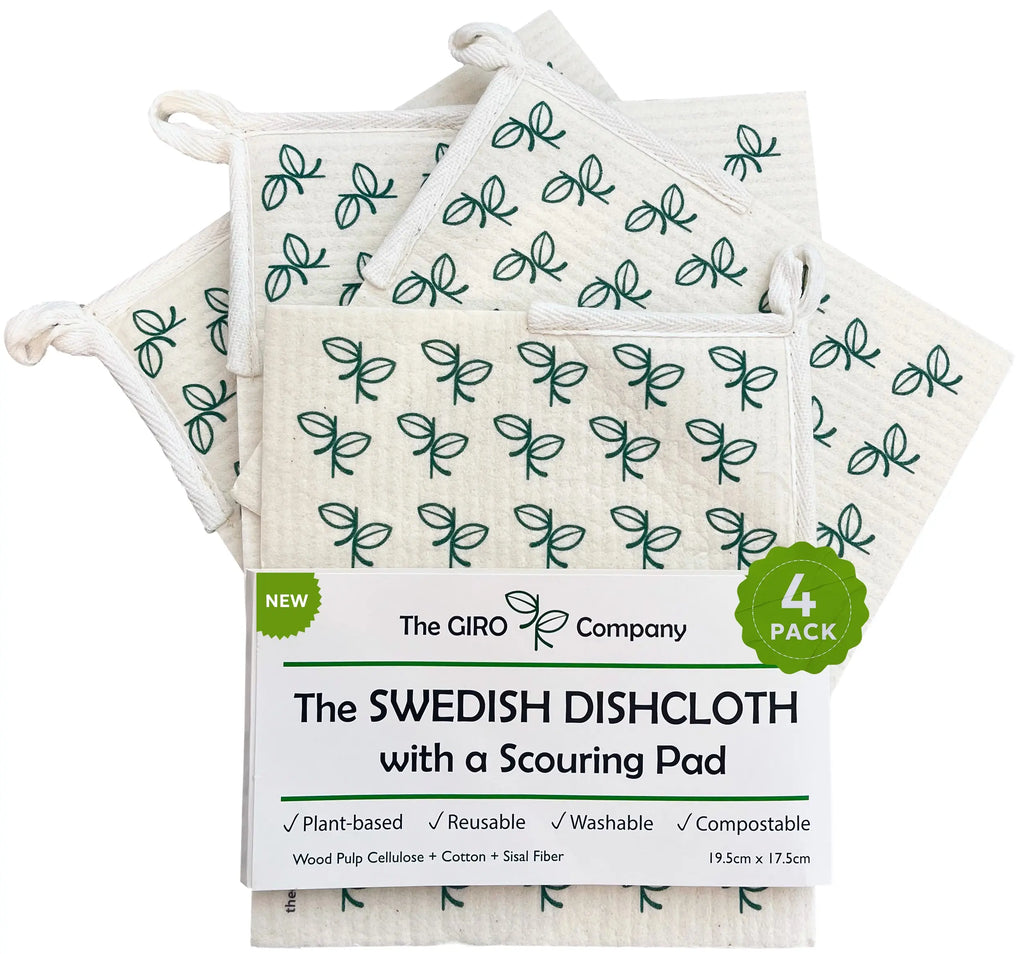
This is the biggest practical difference between cloths. A smooth cloth wipes beautifully and does nothing to dried-on oatmeal, which is why many people keep a sponge around as well. A cloth with a built-in scrubbing area removes that second tool. Ours has a sisal scouring corner, made from a coarse, natural plant fiber. Whatever brand you choose, check what the scrubbing part is made of. A plastic scrubber stitched onto a plant-fiber cloth turns a plastic-free cloth into a mixed-material one that won't fully break down. More on how the corner compares to a sponge in Swedish dishcloth with a scrubber: do you still need a sponge?

4. How it dries (and how you wash it)
One reason these cloths are easier to keep fresh than a sponge is that they dry fast, but only if you can hang them. A sewn-in loop sounds like a tiny feature. In daily use it's the difference between a cloth that dries on a hook or cabinet knob and one left in a soggy heap by the tap.
Check the care instructions too. A good cloth should be easy to clean: Giro cloths can be machine washed or run through the dishwasher (top rack). Use no fabric softener, since it coats the fibers and makes them less absorbent, and hang dry. The full routine is in how to wash a Swedish dishcloth.

5. Inks and testing
Printed cloths should use water-based inks. If a brand claims a textile safety certification (for example OEKO-TEX Standard 100), ask for a certificate number you can look up. Vague "non-toxic" claims with nothing behind them are a yellow flag.
6. Price per cloth, not per pack
Packs range from a few cloths to 20 or more, so compare the price per cloth, not the sticker on the pack. As a rough guide, $2 to $4 per cloth is the normal range for a quality one, and bigger packs usually cost less per cloth. For reference, here's how ours work out:
- 4-pack: $11.96 ($2.99 per cloth)
- 8-pack: $19.98 ($2.50 per cloth)
- 16-pack: $34.96 ($2.19 per cloth)
Then factor in how long a cloth lasts. A good one should last about 2–3 months of daily use, and one cloth can replace up to 15 paper towel rolls over its life (here's the math). Not sure which size to get? See how many Swedish dishcloths you need. Bigger packs also split nicely into a few easy gifts.

7. What happens at the end
Even a great cloth wears out eventually. One made only of cellulose, cotton and plant fiber is plastic-free and made from biodegradable plant fibers, so when it's worn out you can cut it up and add it to a home compost pile. Packaging varies a lot from brand to brand, so if that matters to you, check what it's made of and how to dispose of it.
Quick checklist
- Cellulose and cotton only, no synthetics
- About 7 by 8 inches, with reviews that don't mention thinness
- A way to scrub, made from a natural fiber
- A hanging loop, plus easy care (washer or dishwasher)
- Water-based inks; a certificate number if a certification is claimed
- $2 to $4 per cloth
- A plastic-free cloth made from biodegradable plant fibers, and packaging details you can check
Where Giro fits
We built our cloth around point 3: a sisal scouring corner, plus a hanging loop and a 70% cellulose (plant-based wood pulp) and 30% cotton blend. Each cloth is about 8×7 in, absorbs up to 15x its weight, and can replace up to 15 paper towel rolls. Machine wash or dishwasher top rack, no fabric softener, hang dry, and expect about 2–3 months of daily use. Packs of 4, 8 and 16 work out to between $2.19 and $2.99 per cloth, with free US shipping from San Mateo, California.
FAQ
Are the cheap multi-packs on marketplaces any good?
Some are fine. Check the blend, look for thickness complaints in reviews, and notice whether the seller states what the cloth is made of at all.
Does the print or color matter?
Only to you. Darker or busier prints hide stains better, and that's the whole story.
How many should I buy to start?
Three or four: one in use, one drying, one in the wash, plus a spare. That's why a 4-pack is a good first buy.
How long should a good one last?
About 2–3 months of daily use with regular washing. When it gets thin or frayed, retire it to rag duty or the compost pile.
Can a Swedish dishcloth replace a sponge?
For most wiping, yes. If it has a scrubbing corner like ours, it handles light scrubbing too, so many people drop the sponge altogether.
Questions about choosing a size or pack? Email help@thegirocompany.com.